
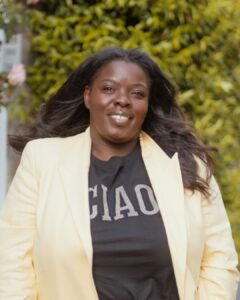
Name: Ms. Charlie-Ann St. Cyr
Home country: Saint Lucia
USC qualifications: Bachelor of Arts in English and Bachelor of Science in Sociology, 2010; Master of Arts in Human Communication, 2013
Field of work: Communication, marketing and social impact
Organisation: Founder, Girls with Roots
At 16, Charlie-Ann St. Cyr left Saint Lucia for Trinidad to begin university. She was travelling without her parents, entering a community of students from across the Caribbean and, though she did not yet know it, beginning the long process of discovering who she was beyond home.
The transition could have been daunting. Instead, USC felt familiar.
St. Cyr had attended the St. Lucia Seventh-day Adventist Academy, part of what she describes as a lifelong experience of Christian education. Her parents, Eileen and Gabriel St. Cyr, had deliberately chosen schools where academic excellence and faith could develop together.
At USC, that continuity mattered. So did the friendships, residence-hall life and easy welcome she found on campus.
“It felt like a never-ending camp, and I never wanted to leave,” she recalls.
Beneath that sense of belonging, a more consequential transformation was unfolding. Exposure to new people, perspectives and possibilities gave St. Cyr room to define herself. Looking back, she recognises that USC provided the right environment at a formative moment—not only educating her, but helping her become more confident in her voice and abilities.
St. Cyr graduated in 2010 with bachelor’s degrees in English and sociology, then completed a Master of Arts in Human Communication in 2013. Today, those disciplines converge in a career spanning communication, marketing and social impact.
English sharpened her ability to write and communicate. Sociology taught her to examine people and the systems shaping their experiences. Human communication helped her bring those insights together.
Her education also changed the questions she asked. Communication was no longer simply about presenting information well. She began considering the problem being solved, the people being reached and the change the work should create.
That shift—from transmitting a message to pursuing an outcome—became central to her professional life.
“My professional training at USC gave me more than just academic knowledge,” she says. “It taught me how to look at the world and consider how I could use my knowledge to shape what happens in it.”
That conviction eventually led her to establish Girls with Roots, an organisation helping girls develop confidence, agency and voice.
St. Cyr saw a gap between what society tells girls and what it equips them to do. Girls are encouraged to become educated, she observes, but qualifications alone do not always prepare them to lead, advocate for themselves or navigate the pressures of adolescence.
Girls with Roots responds to that gap. Through initiatives such as Girls Meet, the organisation creates welcoming spaces in communities and secondary schools where girls can speak openly, receive guidance from trained professionals, build healthy relationships and practise leadership.
The need is practical. Some girls return from school directly to caregiving and household responsibilities. Others lack trusted adults with whom they can discuss difficult experiences. Girls Meet gives them space to pause, ask questions and simply experience being girls.
After several years of piloting the programme, Girls with Roots received support from the Michelle Obama Girls Opportunity Alliance, helping to deepen its work and extend its reach.
For St. Cyr, the partnership affirms an idea that has followed her since USC: she does not have to remain an observer of the problems around her. She can help change something.
Her 16-year-old self could not have imagined that the education she began in Trinidad would contribute to an internationally supported initiative for Caribbean girls. The outcome has strengthened her belief that faith should expand ambition, not restrain it.
“I don’t believe that our faith requires us to dream small,” she says. “Sometimes our dreams are smaller than what God is willing to do through us.”
St. Cyr’s relationship with USC continued after graduation when she returned to serve in the University’s Integrated Marketing and Communications Department. Her tenure included USC’s 90th anniversary, for which she helped tell the institution’s story and produce its commemorative magazine.
The assignment brought her journey full circle. USC had given her opportunities to write, lead and grow. She was now using those abilities to preserve and celebrate the legacy of the institution that developed them.
“There is something very special about returning to the place that poured so much into you and being able to say, ‘Now I have something to pour back,’” she says.
For St. Cyr, that is how institutional legacy endures. A university’s influence should not conclude when a student receives a degree. What it invests in graduates should continue producing value wherever they go.
St. Cyr understands USC’s philosophy of the head, heart and hand more clearly now than she did as a student.
“The head gave me knowledge, the heart gave that knowledge purpose, and the hand taught me that purpose requires action,” she says. “But I would also add that God sits at the centre of all three.”
The philosophy is visible across her journey: in the education that developed her abilities, the compassion that directed them and the work that now places them in service to others.
As USC approaches its second century, St. Cyr hopes its graduates will enter the rooms where important decisions are made—but that achievement will never become their only measure of success. Education creates opportunity, she believes, but it also creates responsibility.
The enduring question is not simply, What can I accomplish with what I have learned? It is also, Who else can rise because I was given this opportunity?
For St. Cyr, the answer continues to take shape in every girl learning to trust her voice, recognise her potential and dream beyond what she once thought possible.