
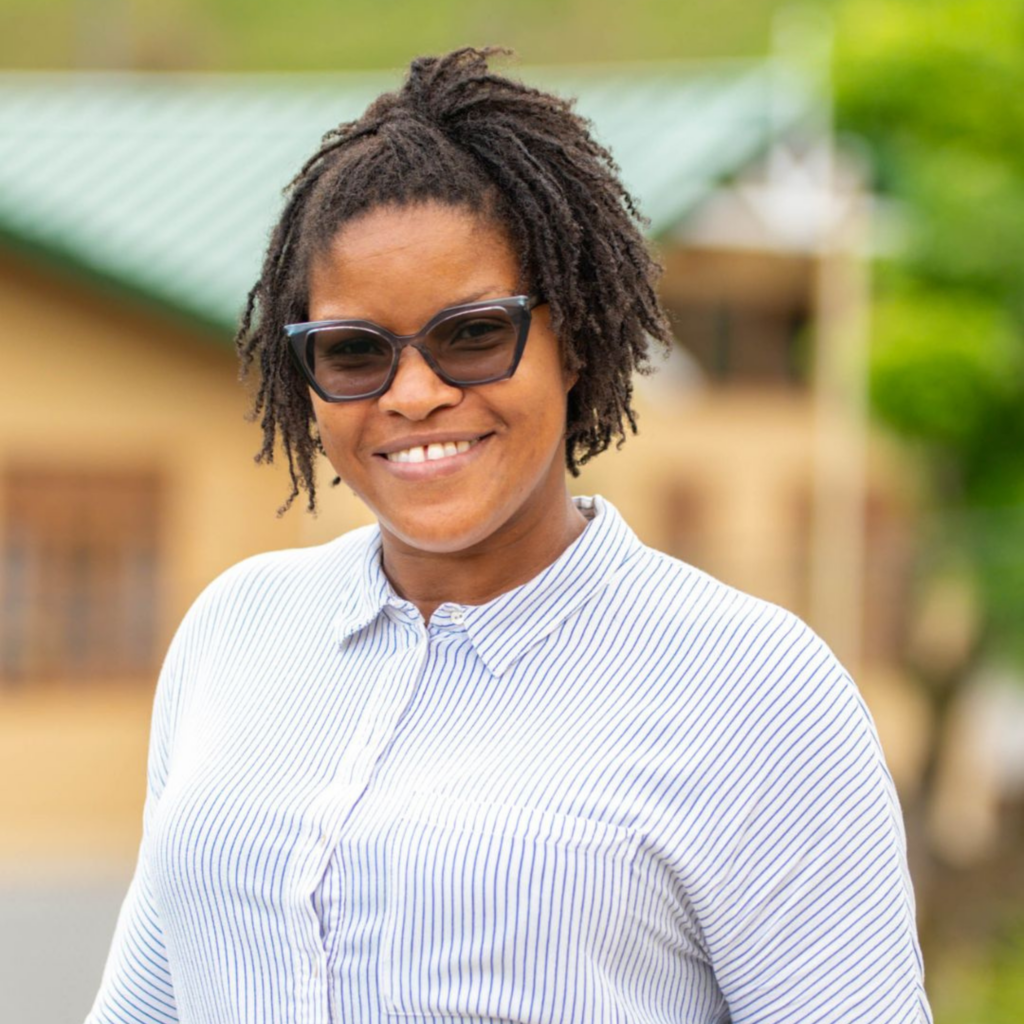
From Martinique to Maracas Valley, one woman’s path to ministry is marked by resistance, surrender, and a quiet, unrelenting call.
Some journeys begin with intention. Others begin with a call. For Line-Rose Bouville, the road to the University of the Southern Caribbean was neither straightforward nor self-selected. It was, in her words, something she resisted for nearly two decades, until she could not anymore.
“I did not choose USC. I did not even understand theology,” she says plainly.
Born and raised in Martinique, Bouville’s life was already anchored in faith, family, and service. A wife and mother of three, she was already deeply engaged in ministry long before she entered a classroom. She preached, led outreach efforts, and served as a personal ministries leader in her home church.
By all visible measures, she was already doing the work. Which is precisely why she did not see the need to study it.
A Call Deferred, Then Answered
The call came early, when she was still a young girl, but readiness did not follow. “I was not ready for that at all,” she recalls. “I delayed.”
For two decades, she built a life around what she could control: family, work, and active lay ministry. Theology, as an academic pursuit, felt unnecessary, almost excessive. “I was preaching… doing crusades… having people baptized,” she says. “I said, ‘I don’t need to study theology. I’m already doing the work.’”
But conviction has a way of returning, often through unexpected voices. One such moment came after a week of meetings in her local conference. A visiting speaker, someone who could not have known her internal wrestlings, turned to her directly with a question that unsettled everything:
“Why are you still in Martinique?” She was stunned. “How do you know that?” she remembers asking. His response was simple and disarming: “If God still calls you, go back on your knees and ask Him.” That night, she did.
What followed was not dramatic, but decisive. Doors began to open through conversations, confirmations, and an unusual alignment of circumstances that felt less like coincidence and more like orchestration.
Even her employer, unprompted, voiced what she had not yet fully said aloud, that one day, she would leave to pursue theology. “It’s like God was speaking everywhere,” she says.
The Language of Faith, and Frustration
If obedience was the first step, the next was far more disruptive. Her intention had been to study in a French-speaking environment, something familiar, manageable, logical. Instead, she felt directed elsewhere. “God said Trinidad,” she says.
The decision made little practical sense. She did not speak English fluently. She had never lived outside her cultural context. And yet, she went, arriving in January 2023 with her entire family, holding onto one quiet assumption: That if God had called her there, He would make it easy.
“I told myself, He will give me the gift of tongues,” she says, laughing softly. He did not.
What followed were months of disorientation. From January to June, she remained in the ESL programme, navigating an environment where language became a daily barrier, not just academically, but socially and emotionally.
“I could write a little. I could understand a little,” she says. “But I was really… dying every day.”
Her husband, who spoke English more comfortably, was adjusting. She was not. “I was frustrated,” she admits. “I said, ‘I cannot understand what you are doing. You’re not even studying theology, and you can speak.’”
Then, in July, everything shifted. Her husband and sons returned home. She stayed, alone. And in that silence, without the comfort of family and familiar language, something unexpected happened.
“As soon as my husband left… it was like God opened my mind.” Language came. Not perfectly, but enough. Understanding followed. Confidence slowly emerged. By September, she began her theology programme.
The transition into academic life brought its own challenges. Trinidad was not just English-speaking, it was multilingual in rhythm, accent, and expression. Classrooms were filled with voices from across the Caribbean, each carrying its own cadence. Lectures moved quickly. Cultural differences added layers of complexity.
“People are speaking so fast… this one speaking this way, this one another way,” she says. “I was like, ‘Oh…’” There were moments of overwhelm. Moments of doubt. But there was also persistence.
“I prayed,” she says simply. “And God led me through.” By the end of her first year, she had not only adjusted, she had excelled. “I had good grades,” she says. “Not because of me. I don’t even know how I did it… but we made it.”
It was not easy. Accents varied. Lectures moved quickly. Cultural differences added layers of complexity. Yet, through prayer and persistence, she not only adjusted—she excelled. “I don’t even know how I did it… but we made it.”
Bouville did not ease her way into campus life. She entered it fully, often before she felt ready. In her first year, she accepted a role as the Associated Student Body representative for non-native English-speaking students. “I had no idea how I would do it,” she says. “But I said yes.”
That pattern continued. She later became Director of Activities within the Ministerial Association. Now, she is preparing to serve as its president. Each role, she insists, was less about ambition than availability. “I don’t know how I ended up there,” she says. “God is just working.”
Her ministry extends beyond structured roles. She actively preaches in churches across Trinidad, including Five Rivers and Lopinot, accepting invitations as they come. There is a quiet consistency to her approach: when called, she responds. “Each time people ask me to preach… I always say yes.”
Ministry in the Everyday
For Bouville, ministry is not confined to pulpits or programmes. It unfolds in ordinary, often unnoticed moments.
It is relational. Immediate. Unscheduled. On campus, she is known not for a title, but for presence—greeting security officers by name, speaking with grounds staff, checking in on students, offering quiet counsel. “I don’t look down on anyone,” she says. “Everybody matters.”
She notices the small things, how people are spoken to, who is overlooked, where kindness is withheld. “Only when you need something, you talk to them?” she challenges. “Or you see them every day?” Her response is intentional: she brings food, starts conversations, lingers.
Even outside campus, the pattern continues. One such encounter, an hour-long conversation about God with a stranger at a grocery store, remains emblematic of her philosophy. She did not hesitate. “Our ministry doesn’t start when we graduate. It starts now.” Not scheduled. Not staged. Simply lived.
Cultural transition brought not only language barriers, but spiritual ones. Coming from a more conservative worship background, Bouville initially struggled with the diversity of expressions she encountered in Trinidad. “I was shocked,” she admits.
Her instinct was to question, even to judge. Then came another quiet correction. “God told me, ‘Stop it. When you see something that shocks you, pray.’” It was a shift that reshaped her posture from critique to compassion. “I learned to pray instead of judge,” she says.
Amid the demands of study and service, Bouville has carved out a discipline of retreat. Each morning, she seeks solitude, venturing into the surrounding hills and natural spaces of campus to reconnect with God. Far from the noise, she prays.
“We study theology, but that doesn’t make us spiritual,” she says. “We still need that personal connection.”
It is there, in stillness, that she recalibrates—reminding herself that knowledge and intimacy with God are not the same; anchoring her in a journey that is anything but predictable.
As graduation approaches, Mrs. Bouville resists the pressure to define what comes next. “I don’t know at all,” she says with a smile. What she does know is this: the same God who led her here will lead her forward.
She hopes to continue working in an English-speaking environment, an unexpected desire for someone who once struggled to form a sentence. But beyond that, she remains open. Faith, for her, is not about certainty. It is about trust.
To those who sense a calling but hesitate, her counsel is direct, shaped not by theory, but experience. “God is looking for people who will have the courage to say yes,” she says.
It is not, she is quick to add, an easy path. “There are days I feel like I want to die, it is so difficult,” she admits. But difficulty, for her, is not evidence of absence. “God is always there… saying, continue.”
And then, simply: “Where God leads you is the safest place to be.” It is a promise of presence, and for Mrs. Line-Rose Bouville, that has been enough.