
Professional Development Institute
Quick Links
Upcoming Courses - Term II (May to August 2026)
April
April
30
Occupational Health & Safety
Cohort is now closed, new cohort in Term III. Thursdays | 9am - 4pm AST TT$2,500 | USD$400
April
30
Occupational Health & Safety
Course Description
This course provides comprehensive training in workplace health and safety aligned with Occupational Safety and Health Administration (OSHA) General Industry standards. It is designed for professionals responsible for maintaining safe working environments and ensuring regulatory compliance across industrial, commercial, and service sectors.
Participants will gain practical knowledge and hands-on skills to identify workplace hazards, implement effective safety management systems, and promote a culture of safety within their organisations. The programme emphasises real-world application, enabling learners to reduce operational risks, prevent workplace incidents, and support compliance with occupational health and safety regulations.
Learning Outcomes
By the end of this course, participants will be able to:
- Explain OSHA General Industry standards and relevant regulatory frameworks
- Conduct workplace inspections and identify occupational hazards
- Apply safety management practices to reduce workplace risks
- Implement emergency action plans and fire protection procedures
- Demonstrate safe handling of machinery, tools, and electrical systems
Content
Outline of the course structure:
- Introduction to OSH Act, OSHA Standards (Regulatory Framework and Safety Management)
- Workplace Hazard Identification and Prevention
- Equipment and Operational Safety
- Chemical and Environmental Safety
- Workplace Safety Systems and Specialised hazards
Why take this course?
- OSHES Limited certification will be issued on successful completion of the
course. - Gain practical, industry-relevant workplace safety skills aligned with OSHA standards
- Enhance your ability to identify hazards and prevent workplace incidents
- Strengthen organisational compliance with occupational health and safety regulations
- Build competence as a health, safety, and environmental (HSE) professional
June
June
01
Real Estate Brokerage and Agency Principles
June 1 – July 8, 2026 Mon & Wed | 5pm - 7pm AST TT$4,000 | USD$600
June
01
Real Estate Brokerage and Agency Principles
CQF-L 6* | This Course is Offered Virtually
Course Description
This Professional Certificate in Real Estate Brokerage & Agency Principles is designed to equip participants with the knowledge and practical competencies required to operate as effective and ethical real estate professionals. Aligned with international best practices and guided by the United Kingdom Professional Standards Framework (UKPSF), the course prepares individuals to deliver high-quality brokerage services in a competitive and evolving market.
Ideal for aspiring real estate agents and industry professionals, the programme covers essential areas such as property knowledge, market analysis, valuation, sales, and negotiation. Participants will gain practical insights into the full real estate transaction process, enabling them to build client trust, support informed investment decisions, and contribute to a more professional and credible real estate sector.
Learning Outcomes
By the end of this course, participants will be able to:
- Explain the structure of the real estate industry and the roles of key stakeholders
- Apply ethical standards and professional practices in real estate brokerage
- Conduct property inspections and provide informed, needs-based advice
- Apply valuation methods and understand key factors influencing property value
- Demonstrate effective sales and negotiation techniques in real estate transactions 5
Content
Outline of the course structure:
- What is Real Estate?
- Realtor Ethics and Professional Practice
- Knowing Your Market
- Knowing Your Property
- The Mortgage Process & Sale Closing
- Listing leads
- Property Appraising and Estimation
- Sales Techniques & Negotiation
- Sustainability & The Built Environment
- Practicing Real Estate
About Instructor
Mr. Ryan Joseph, MRICS, RV, BSc, Cert
Managing Director / The Property Vault
Ryan Joseph is a Chartered Valuation Surveyor, Real Estate Broker, and lecturer with over 15 years of experience in real estate brokerage, valuation, and sustainable property practices. As Managing Director of The Property Vault, he specialises in property valuation, brokerage, sustainability, and professional ethics. Ryan is also an Ambassador for the Royal Institution of Chartered Surveyors (RICS).
Mr Stephen Joseph, BSc
Director / The Property Vault
Stephen Joseph is a Real Estate Broker, Property Inspector, marketer, and lecturer with over 15 years of experience in real estate brokerage, property inspection, marketing, and business development. He currently serves as Director of The Property Vault and specialises in property brokerage, inspection, marketing strategy, and real estate education.
Why take this course?
- Develop practical, job-ready skills for real estate brokerage and agency practice
- Gain industry-relevant knowledge aligned with international professional standards
- Enhance your ability to build trust and credibility with clients and stakeholders
- Strengthen your career opportunities in the real estate and property sector
June
07
Drone Operation and Safety Management
June 7 – June 14, 2026 Sundays | 9:00 AM – 3:30 PM TT$2,000 | USD$300
June
07
Drone Operation and Safety Management
Drone Operations & Management
Course Description
This introductory course provides participants with essential knowledge and practical skills in drone (Unmanned Aerial Vehicle – UAV) operations, with a strong focus on Caribbean environments. It explores the fundamentals of flight planning, aerodynamics, safety, and payload management, while addressing regional challenges such as weather patterns, terrain, and airspace restrictions.
Designed for beginners and professionals seeking to enter the UAV field, the course combines theory with practical application through scenario-based exercises and mission planning activities. Participants will learn how to operate drones safely and efficiently while understanding the regulatory and environmental considerations unique to the Caribbean. By the end of the course, learners will be equipped to plan and execute basic UAV missions with confidence and awareness.
Learning Outcomes
By the end of this course, participants will be able to:
- Analyse flight planning requirements for UAV operations within Caribbean contexts
- Apply key flight terminology and operational principles in real-world scenarios
- Evaluate environmental and operational risks affecting drone performance
- Design basic UAV mission plans incorporating safety and regulatory considerations
- Assess the impact of payloads on UAV flight performance and operational efficiency
Content
Outline of the course structure:
- Introduction to UAV Operations
- Flight Planning and Airspace Awareness
- Aerodynamics and Environmental Factors
- Safe Flight Operations
- Payloads and Mission Execution
About Instructor
Mr Connell Byron Hunte, MSc, PGDip, BSc
Instructor, Department of Computer Science / The University of the Southern Caribbean
Connell Byron Hunte is a computing educator, technology consultant, and systems specialist with over 30 years of experience in information technology, software development, digital systems, and industrial chemistry. He currently lectures in Computer Science at the University of the Southern Caribbean, where he teaches software development, databases, cloud computing, and web technologies. Connell also consults in IoT systems, AI applications, digital transformation, and technology governance across the Caribbean.
Why take this course?
- Gain practical, hands-on knowledge of drone operations and flight planning
- Understand region-specific challenges affecting UAV use in the Caribbean
- Develop foundational skills for entry into drone-related industries and services
- Build confidence in safe, compliant, and effective UAV mission execution
June
08
Intelligence Analysis
June 8 – August 26, 2026 Mon & Wed | 5:30pm – 8:30pm AST TT$7,500 | USD$1,100 Virtual
June
08
Intelligence Analysis
CQF-L 6 | This Course is Offered Virtually
Course Description
The course in Intelligence Analysis is a 12-week advanced programme designed to equip
professionals with the analytical skills and methodologies required to operate effectively in complex security and investigative environments. Developed in response to evolving global and regional threats, including organised crime, cyber risks, and geopolitical instability, this course provides a structured, practice-oriented approach to intelligence production.
Designed for professionals in law enforcement, national security, corporate security, and financial services, the programme blends academic rigour with real-world application. Participants will learn to apply the Intelligence Cycle, utilise structured analytic techniques, and produce clear, actionable intelligence to support strategic and operational decision-making.
Learning Outcomes
By the end of this course, participants will be able to:
- Analyse and apply the Intelligence Cycle within investigative and organisational contexts
- Utilise structured frameworks such as 5W+H to define and refine intelligence problems
- Differentiate between strategic and tactical intelligence and apply appropriate methodologies
- Apply Structured Analytic Techniques (SATs) to support evidence-based analysis
- Produce clear, concise, and actionable intelligence reports for decision-makers
Content
Outline of the course structure:
- Introduction to Intelligence Analysis
- The Intelligence Cycle
- The 5W+H Framework
- Collation Discipline
- Strategic & Tactical Intelligence Analysis
- SMART System of Planning
- Structured Analytic Techniques
- Capstone Simulation
- Developing Human Contacts
- Report Writing
About Instructor
Mr Brent Clement
(Intelligence Practitioner and Security Analyst)
Mr Clement is a Strategic Intelligence Executive and Digital Forensics Expert with nearly 30 years of experience in national security, intelligence analysis, and counterterrorism. A Certified INTERPOL Instructor and experienced lecturer, he specialises in intelligence fusion, cybercrime investigations, and strategic investigative frameworks. He has worked extensively with international agencies and is recognised for developing innovative intelligence-led training models that bridge global best practices with regional security needs.
Why take this course?
- Develop advanced, practical intelligence analysis skills applicable to real-world scenarios
- Gain expertise in globally recognised analytic frameworks and structured methodologies
- Enhance career opportunities in national security, law enforcement, and corporate intelligence
- Build the capacity to support high-level decision-making in complex operational environments
June
15
Risk Management and Resilience
Module 1: June 15 – July 15, 2026 Module 2: August 3 – September 2, 2026 Mon & Wed | 5:30pm – 7:30pm AST TT$4,000 | USD$600 Virtual
June
15
Risk Management and Resilience
CQF-L 6 | This Course is Offered Virtually
Course Description
This course provides a comprehensive exploration of the principles, frameworks, and practices required to effectively identify, assess, and mitigate risk while building organisational and individual resilience. Aligned with international standards such as ISO 31000 and ISO 22301, the course combines theoretical knowledge with practical application through case studies and simulations.
Designed for professionals across sectors, particularly within the Caribbean context, this course equips participants with the tools to analyse risks, prioritise responses, and develop resilience strategies that support business continuity. Participants will gain hands-on experience in applying risk management frameworks and designing systems that enable organisations to adapt and thrive in the face of disruption.
Learning Outcomes
By the end of this course, participants will be able to:
- Explain key principles and frameworks underpinning risk management and resilience
- Apply methodologies for risk identification, assessment, and evaluation
- Evaluate organisational risks against defined appetite and impact scales
Integrate resilience strategies into organisational and operational planning - Apply crisis management and business continuity practices in real-world contexts
Content
Outline the structure of the course:
- Foundations of Risk and Resilience
- Risk Identification and Analysis
- Evaluating Likelihood and Impact
- Defining and Applying Risk Appetite
- Organisational Resilience
- Human-Centred Resilience
- Business Continuity Planning
- Business Impact Analysis
- Crisis governance and Leadership
- Crisis Communication and Accountability
- Occupational Health and Safety Risk Management
- Recovery and Continuity Testing
- Integrating Risk and Resilience
- International Case Studies in Risk and Resilience
About Instructor
Ms Chantelle Drummonds, BBA, SFC, SSYB
Risk Manager / Jamaica Civil Aviation Authority
Chantelle Drummonds is an Enterprise Risk Management professional with over six years of experience in risk governance, business continuity, internal auditing, and strategic planning. She currently serves as Risk Manager at the Jamaica Civil Aviation Authority and lectures in Crisis and Risk Management at The University of the West Indies, Five Islands Campus. She is certified in ISO 31000 Risk Management, ISO 22301 Business Continuity, and ISO 9001 Quality Management Systems.
Why take this course?
- Develop practical skills in risk identification, analysis, and mitigation
- Gain working knowledge of internationally recognised ISO risk and resilience standards
- Strengthen your ability to manage crises and ensure organisational continuity
- Enhance your professional profile in risk management, safety, and organisational leadership
June
15
Introduction to Instrumentation and Orchestration
June 15 – July 23, 2026 Mon & Wed | 5:30pm – 8:30pm AST TT$2,500 | USD$400
June
15
Introduction to Instrumentation and Orchestration
CQF-L 7 | This Course is Offered In-Person
Course Description
This foundational course introduces participants to the principles and practices of writing for orchestral instruments. It explores the capabilities, limitations, and expressive qualities of instruments across orchestral families, while examining how they combine to create balance, texture, and tonal colour. Designed for individuals with intermediate music literacy, the course is ideal for aspiring composers, arrangers, and music educators seeking to deepen their understanding of orchestration.
Participants will engage with both technical and artistic aspects of composition, including score analysis, listening exercises, and practical writing tasks. By the end of the course, learners will be equipped to compose idiomatically for individual instruments and small ensembles, while developing their own creative voice through guided exploration of classical and contemporary works.
Learning Outcomes
By the end of this course, participants will be able to:
- Analyse the ranges, registers, and technical capabilities of orchestral instruments
- Apply principles of instrumentation to compose idiomatic parts for individual instruments
- Design effective instrumental combinations to achieve desired tonal and timbral effects
- Evaluate orchestral scores to identify compositional techniques and stylistic approaches
- Produce basic orchestral arrangements using notation software and structured scoring methods
Content
Outline of the course structure:
- The Orchestra and Its Families – Understanding instrument groups and roles
- Instrument Anatomy and Performance Techniques – How instruments produce sound
- Articulation and Expression – Bowing, tonguing, and phrasing techniques
- Ranges, Registers, and Orchestral Colour – Balancing sound and texture
- Orchestration in Practice – Score analysis, composition, and arranging
About Instructor
Mokale Koapeng, MMus, HDE
Instructor, University of the Southern Caribbean
Mokale Koapeng is a distinguished composer, conductor, music educator, and lecturer with over 40 years of experience in music education, choral composition, conducting, and African music studies. He currently lectures at the University of the Southern Caribbean and has taught at leading institutions including the University of South Africa and the University of the Witwatersrand. His internationally recognised work spans composition, orchestration, music history, conducting, and music business.
Why take this course?
- Develop practical composition and orchestration skills through hands-on learning
- Gain in-depth knowledge of instrumental capabilities and orchestral writing techniques
- Build a portfolio of original arrangements and compositions
- Strengthen pathways into music production, composition, and academic study
June
15
Special Education for Professionals
CQF-L 8 | This Course is Offered Virtually
Module I–III: June 15 – September 3, 2026 Module IV–VI: September 14 – December 3, 2026 5pm – 8pm AST TT$12,000 | USD$1,800 Per Module – TT$2,000 | USD$300
June
15
Special Education for Professionals
CQF-L 8 | This Course is Offered Virtually
June
16
Introduction to Music Business
June 16 – July 24, 2025 Tue & Thurs | 5:30pm – 8:30pm AST TT$2,500 | USD$400
June
16
Introduction to Music Business
CQF-L 7 | This Course is Offered In-Person
Course Description
This course provides a comprehensive introduction to the music industry, with a focus on the legal, business, and commercial aspects that drive music production and distribution. Participants will explore how artists, managers, producers, and industry stakeholders collaborate to create, promote, and monetise music in a rapidly evolving digital landscape.
Designed for aspiring artists, managers, producers, and entrepreneurs, the course examines key areas such as copyright, publishing, royalties, branding, marketing, and digital distribution. Through case studies, simulations, and practical assignments, participants will gain insight into industry trends, emerging technologies, and strategies for building sustainable music careers. By the end of the course, learners will understand how the music business operates and how to navigate it effectively.
Learning Outcomes
By the end of this course, participants will be able to:
- Analyse the structure and key stakeholders within the music industry
- Explain copyright laws, publishing, and royalty systems in music
- Apply branding and marketing strategies to promote artists and music products
- Evaluate digital distribution platforms and monetisation opportunities
- Design basic event and artist management strategies within the music business
Content
Outline of the course structure:
- The Music Industry Landscape – History, structure, and key stakeholders
- Legal Foundations and Copyright – Rights, agreements, and publishing
- Monetisation and Revenue Streams – Royalties and income models
- Branding, Promotion, and Marketing – Building and promoting an artist
- Digital Distribution and Industry Practice – Streaming, platforms, and real-world application
About Instructor
Mr Mokale Koapeng, MMus, HDE
Industry Professional | Instructor, University of the Southern Caribbean(Industry
Mokale Koapeng is a distinguished composer, conductor, music educator, and lecturer with over 40 years of experience in music education, choral composition, conducting, and African music studies. He currently lectures at the University of the Southern Caribbean and has taught at leading institutions including the University of South Africa and the University of the Witwatersrand. His internationally recognised work spans composition, orchestration, music history, conducting, and music business.
Why take this course?
- Gain practical insight into how the music industry operates locally and globally
- Develop essential business and legal knowledge for managing music careers
- Learn strategies for marketing, branding, and monetising music effectively
- Build real-world skills through projects, simulations, and industry-based learning
June
16
Introduction to Music Technology
June 16 – August 6, 2026 Tue & Thurs | 5pm – 8pm AST TT$2,500 | USD$400
June
16
Introduction to Music Technology
CQF-L 7 | This Course is Offered In-Person
Course Description
This introductory course provides a practical foundation in music technology, focusing on recording, editing, and basic mixing techniques. Designed for beginners, it introduces participants to essential concepts such as signal flow, gain staging, microphone techniques, and multi-track recording using industry-standard software and equipment.
Ideal for aspiring musicians, producers, and media practitioners, the course emphasises hands-on learning through guided workshops and real-world projects. Participants will gain experience recording instruments and vocals, organising sessions, and producing a simple multi-track recording. By the end of the course, learners will have developed core technical skills and confidence to pursue further study or creative work in music production and audio technology.
Learning Outcomes
By the end of this course, participants will be able to:
- Explain fundamental music technology concepts, including signal flow and gain staging
- Apply microphone selection and placement techniques for recording instruments and vocals
- Record and mix simple audio projects using industry-standard software
- Create and manage multi-track recording sessions effectively
- Evaluate audio recordings and apply basic improvements in sound quality
Module Titles
Outline of the course structure:
- Introduction to Music Technology – Core concepts and studio overview
- Recording Fundamentals – Signal flow, gain staging, and setup
- Recording Instruments – Techniques for capturing live instruments
- Recording Vocals and Keyboards – Voice recording and MIDI integration
- Mixing and Final Project – Basic mixing and project completion
About Instructor
Mr Andre Jack
(Part-Time Lecturer, University of the Southern Caribbean)
Andre Jack is a music educator and audio practitioner with a Master of Music degree and experience in music technology instruction. He specialises in recording and mixing techniques, combining technical expertise with a hands-on teaching approach. His work focuses on helping beginners develop practical studio skills, guiding students through real-world audio production processes using industry-standard tools and workflows.
Why take this course?
- Gain hands-on experience with real recording and mixing tools and techniques
- Develop practical skills applicable to music, media, and content creation
- Build a foundational portfolio through guided audio projects
- Prepare for advanced study or entry-level opportunities in music production
July
July
01
Music Production and Sound Engineering
July 1 – August 26, 2026 Wednesdays | 6pm - 8pm AST TT$3,000 | USD$450
July
01
Music Production and Sound Engineering
Music Production and Sound Engineering, Basic
CQF-L 6 | This Course is Offered Virtually
Course Description
This course provides a practical introduction to music production and sound engineering for beginners with little or no prior experience. Participants will explore the fundamental principles of sound, audio equipment, recording techniques, and digital audio workstations, alongside essential skills in mixing, mastering, and live sound operation.
Ideal for aspiring producers, musicians, church media teams, and individuals interested in audio technology, the course combines studio-based learning with live sound applications. Emphasis is placed on hands-on practice, workflow development, and safe equipment use. By the end of the course, participants will have the foundational skills needed to produce audio content and operate basic sound systems in both studio and live environments.
Learning Outcomes
By the end of this course, participants will be able to:
- Explain fundamental concepts of sound and audio production
- Operate basic audio equipment and digital audio workstations
- Apply recording techniques for vocals and simple instruments
- Use basic editing, mixing, and audio processing techniques
- Set up and manage a basic live sound system safely and effectively
Content
Outline of the course structure:
- Introduction to Music Production and Audio Fundamentals
- Studio Equipment and Digital Workflows
- Editing and Music Production Techniques
- Mixing, Mastering, and Audio Output
- Live Sound and Professional Practice
About Instructor
Mr Judah Peters, BFA, Cert. Music Technology
CEO | Redemption Studios by Judah Peters Ltd
Judah Peters is a Music and Audio Production Instructor, multimedia producer, and audio systems consultant with over 15 years of experience in music training, worship leadership, and studio production. As CEO of Redemption Studios by Judah Peters Ltd, he has produced more than 260 songs and specialises in music production, live sound, livestream audio, and ensemble training. Judah is recognised for delivering practical, industry-focused instruction grounded in real-world studio and ministry environments.
Why take this course?
- Gain hands-on experience in music production and sound engineering fundamentals
- Learn industry-relevant skills for studio recording and live sound environments
- Build a foundation for careers in audio production, media, and live events
- Develop practical skills applicable to music, church production, and digital media
July
06
Youth Leadership Development in Sports
July 6 – July 17, 2026 Mon - Thurs | 9am - 3:30pm AST Fridays | 9am - 12noon AST TT$3,000 | USD$450
July
06
Youth Leadership Development in Sports
CQF-L 6 | This Course is in Person
Course Description
Youth Leadership in Sport is a practical, hands-on course designed to equip young leaders with the skills and knowledge to use sport as a powerful tool for personal and community development. The course introduces key concepts in youth leadership, coaching, ethics, and inclusive practice, while exploring the role of sport in promoting positive social outcomes.
Ideal for youth leaders, coaches, educators, and individuals working with young people, this course provides a strong foundation in sport-based leadership approaches. Participants will learn how to foster teamwork, manage conflict, and create inclusive sporting environments. The programme emphasises real-world application, empowering participants to lead effectively and contribute to youth development within their communities.
Learning Outcomes
By the end of this course, participants will be able to:
- Explain key concepts and principles of youth leadership in sport
- Analyse the role of sport in youth development and community building
- Apply ethical principles and promote fair play in sporting environments
- Demonstrate coaching techniques suitable for youth engagement
- Apply conflict management and problem-solving strategies in sport settings
Content
Outline of the course structure:
- Foundations of Youth Leadership in Sport
- Youth Development through Sport
- Module 3: Ethics and Law in Youth Sport
- Coaching and Inclusive Practice
- Conflict Management and Community Engagement
About Instructor
Mr Leroy Pierre, MA, Bsc, CPT
Coordinator, Sports and Physical Education Department / University of the Southern Caribbean
Le-Roy Pierre is a certified personal trainer, sports educator and wellness professional with more than 35 years of experience in physical education, fitness, wellness and sports administration. He currently serves as Coordinator of the Sports and Physical Education Department and Assistant Wellness Director at the University of the Southern Caribbean. His expertise includes sports management, fitness coaching, wellness programming, event coordination and community health promotion.
Why take this course?
- Develop practical leadership and coaching skills using sport as a development tool
- Gain knowledge of ethical, inclusive, and effective youth engagement strategies
- Build capacity to support positive youth development and community impact
- Enhance your ability to lead, mentor, and inspire young people through sport
July
06
Multimedia Painting
July 6 – July 17, 2026 Mon - Thurs | 9am - 4pm AST Fridays | 9am - 12noon AST TT$3,000 | USD$450
July
06
Multimedia Painting
Multimedia Painting
CQF-L 6 | This Course is Offered In-Person
Course Description
This practical and engaging course introduces participants to the creative world of multimedia painting through hands-on studio activities, discussions, critiques, and guided experimentation with mixed media techniques. Designed for CSEC students, beginner painters, and art enthusiasts, the course explores water-based painting methods, collage techniques, texture development, and mixed media composition.
Participants will develop foundational artistic skills while learning to combine materials creatively to produce expressive and visually compelling artworks. The course also supports portfolio development, artistic confidence, and reflective practice, making it ideal for individuals interested in personal enrichment, therapeutic creativity, or future art studies. By the end of the course, participants will complete an original mixed-media painting project demonstrating their technical growth and creative identity.
Learning Outcomes
By the end of this course, participants will be able to:
- Apply foundational mixed media painting techniques using a variety of materials and tools.
- Analyse the role of texture, composition, and colour in visual storytelling.
- Create original mixed-media artworks that demonstrate creativity and technical skill.
- Evaluate artworks using appropriate artistic terminology and constructive critique methods.
- Develop a portfolio-ready final project that reflects personal artistic growth and experimentation.
Content
Outline of the course structure:
- Introduction to Painting Media
- Understanding Texture and Composition
- Collage and Mixed Media Techniques
- Water-Based Painting Applications
- Final Mixed Media Project and Critique
About Instructor
Mr Oliver Smith, BA (Fine Arts), Cert. Painting
Visual Arts Instructor / E.R. Burrowes School of Art
Oliver Smith is a Painting and Drawing Instructor with over 20 years of experience in visual arts education and creative practice. He currently teaches at the E.R. Burrowes School of Art, where he specialises in painting and drawing techniques. Oliver is also a vocal instructor and sound engineer, combining his passion for the arts, music, and creative expression to inspire students and emerging artists.
Why take this course?
- Develop practical, hands-on mixed media painting and collage skills.
- Gain foundational knowledge of contemporary painting materials and techniques.
- Build a portfolio-ready artwork suitable for academic or personal creative development.
- Strengthen creativity, critical thinking, and self-expression through guided artistic practice.
July
14
Fundamentals of Video Editing
July 14 – August 18, 2026 Tue & Thurs | 6pm - 8pm AST TT$3,000 | USD$450
July
14
Fundamentals of Video Editing
CQF-L 6 | This Course is Offered Virtually
Course Description
Fundamentals of Video Editing is a beginner-friendly, six-week course designed to introduce participants to the essential principles of video editing, storytelling, and production workflow. The course focuses on developing practical skills using industry-standard editing software, enabling learners to create polished, professional-quality video content.
Ideal for aspiring editors, content creators, and professionals working in media and communications, the course covers key areas such as editing techniques, narrative structure, social media formats, and basic audio and colour correction. Participants will engage in hands-on projects and assignments, culminating in a portfolio-ready final edit suitable for social media and corporate use.
Learning Outcomes
By the end of this course, participants will be able to:
- Explain key video editing concepts, terminology, and techniques
- Apply efficient workflow and media organisation practices
- Use storytelling principles to create engaging video content
- Produce platform-ready videos for social media and professional use
- Apply basic audio enhancement and colour correction techniques
Content
Outline of the course structure:
- Editing Fundamentals
- Workflow & Organisation
- Storytelling & Interview Editing
- Social Media Editing Formats
- Audio & Colour
About Instructor
Mr David Barker
Multimedia & Digital Marketing Specialist | Ten Strings Developmental Company
David Barker is a videographer, media producer and digital marketing professional with more than 15 years of experience in multimedia production, youth development and digital communications. As Founder and CEO of Ten Strings Developmental Company, he has led projects in video production, branding and digital strategy for regional organisations and public health campaigns. His expertise includes cinematography, digital marketing, content creation and media production for corporate and community-focused initiatives.
Why take this course?
- Gain practical, hands-on experience using industry-standard editing tools
- Learn to create engaging, professional-quality video content
- Build a portfolio-ready project for social media or corporate use
- Develop skills relevant to careers in media, marketing, and content creation
August
August
03
Foundations of Vegetarian Cuisine
August 3 – August 14, 2026 Mon - Thurs | 9am - 3:30pm AST Fridays | 9am - 12noon AST TT$3,000 | USD$450
August
03
Foundations of Vegetarian Cuisine
CQF-L 6 | This Course is Offered In-Person
Course Description
Foundations of Vegetarian Cuisine is an intensive, hands-on course designed to introduce participants to the principles and practices of plant-based cooking. Over two weeks, learners will explore the nutritional foundations of vegetarian diets while developing practical culinary skills in a professional kitchen environment.
Ideal for beginners, food enthusiasts, and individuals seeking to transition to plant-forward living, the course combines theory with daily kitchen labs. Participants will learn to prepare balanced vegetarian meals using local and international techniques, while gaining confidence in food preparation, meal planning, and flavour development. The course culminates in a final “Community Harvest” showcase, where participants present their culinary creations.
Learning Outcomes
By the end of this course, participants will be able to:
- Explain the nutritional principles of vegetarian diets, including protein pairing and essential nutrients
- Apply safe kitchen practices and demonstrate fundamental culinary techniques
- Prepare a variety of vegetarian dishes using diverse cooking methods
- Design balanced and cost-effective plant-based meal plans
- Demonstrate creativity and competence in producing complete vegetarian meals
Content
Outline of the course structure:
- Foundations of Vegetarian Cooking
- Plant-Based Proteins and Flavour Development
- Global and Caribbean Vegetarian Cuisine
- Advanced Plant-Based Cooking
- Culinary Application and Final Showcase
About Instructor
Ms Lasandra Williams, BSc., Dip.Ed.
Lasandra Williams is a nutrition and culinary professional with more than 15 years of experience in food service management, catering and health-focused meal preparation. She holds a Bachelor of Science degree in Family and Consumer Science with an emphasis in Nutrition from Andrews University and a Diploma in Education from the University of the Southern Caribbean. Her expertise includes vegetarian and vegan cuisine, food operations management and large-scale catering coordination.
Why take this course?
- Gain hands-on experience in preparing nutritious and flavourful vegetarian meals
- Learn practical skills for transitioning to a plant-based or plant-forward lifestyle
- Develop confidence in meal planning, cooking techniques, and kitchen safety
- Build culinary skills applicable to personal, community, or professional settings
August
03
Fancy Homemade Desserts
August 3 – August 14, 2026 Mon - Thurs | 9am - 3:30pm AST Fridays | 9am - 12noon AST TT$3,000 | USD$450
August
03
Fancy Homemade Desserts
Fancy Home-made Desserts
CQF-L 6 | This Course is Offered In-Person
Course Description
Fancy Homemade Desserts is an intensive, hands-on culinary course designed to transform home baking skills into professional-level dessert creation. Over two weeks, participants will explore advanced techniques in pastry, chocolate work, sugar crafting, and plated dessert presentation.
Ideal for passionate home bakers, aspiring pastry chefs, and culinary enthusiasts, this course focuses on both technical precision and artistic expression. Participants will learn to balance textures, flavours, and visual presentation while developing confidence in executing complex desserts. Through guided practice and expert instruction, learners will create refined, restaurant-quality desserts and complete a final showpiece that demonstrates their mastery of advanced baking and presentation techniques.
Learning Outcomes
By the end of this course, participants will be able to:
- Explain the science behind advanced dessert preparation, including sugar work and stabilised creams
- Apply professional pastry techniques such as piping, glazing, and chocolate tempering
- Create complex desserts using advanced methods including pâte à choux and layered cakes
- Design and present visually striking plated desserts with balanced textures and flavours
- Demonstrate disciplined kitchen workflow and precision in dessert production
Content
Outline of the course structure:
- Foundations of Gourmet Desserts
- Chocolate and Sugar Techniques
- Advanced Pastry and Doughs
- Dessert Design and Presentation
- Showpiece Creation and Final Assessment
About Instructor
Ms Kereda Wellington,BSc.
Kereda Wellington is a culinary professional and pastry specialist with over 10 years of experience in catering, baking and food service operations. She holds a Bachelor of Science degree in Family and Consumer Science from the University of the Southern Caribbean and a Certificate in Catering with distinction from the Samuel Jackman Prescod Polytechnic. Her expertise includes pastry creation, culinary preparation, catering services and event support.
Why take this course?
- Master advanced dessert-making techniques used in professional pastry kitchens
- Develop artistic skills in plating and presentation for high-end desserts
- Gain hands-on experience in creating complex, visually impressive baked goods
- Elevate your baking skills for personal enjoyment or professional opportunities
August
25
Social Media & Corporate Video Production
August 25 – September 27, 2026 Tuesdays | 6pm - 8pm AST Sundays | 10am - 2pm AST TT$3,000 | USD$450
August
25
Social Media & Corporate Video Production
Social Media and Corporate Video Production
CQF-L 6 | This Course is Offered Blended
Course Description
Social Media & Corporate Video Production is a practical, hands-on course designed to equip participants with the skills to create professional-quality video content for digital and corporate environments. Over six weeks, participants will learn how to plan, shoot, and produce engaging videos using accessible tools such as smartphones and cameras.
Ideal for content creators, marketing professionals, and individuals seeking to enhance their digital communication skills, the course covers key areas including pre-production planning, lighting, audio, filming techniques, and editing workflows. Participants will develop real-world competencies and complete a corporate-ready video project suitable for social media platforms and professional use.
Learning Outcomes
By the end of this course, participants will be able to:
- Plan and structure effective video content for social media and corporate platforms
- Capture high-quality visuals using smartphones and camera equipment
- Apply appropriate lighting and audio techniques for professional results
- Produce interviews, testimonials, and promotional video content
- Deliver optimised video content for digital and corporate distribution
Content
Outline of the course structure:
- Planning & Pre-Production
- Camera & Smartphone Production
- Lighting & Audio Essentials
- Corporate Production Techniques
- Editing for Social & Corporate Platforms
About Instructor
Mr David Barker
Multimedia & Digital Marketing Specialist | Ten Strings Developmental Company
David Barker is a videographer, media producer and digital marketing professional with more than 15 years of experience in multimedia production, youth development and digital communications. As Founder and CEO of Ten Strings Developmental Company, he has led projects in video production, branding and digital strategy for regional organisations and public health campaigns. His expertise includes cinematography, digital marketing, content creation and media production for corporate and community-focused initiatives.
Why take this course?
- Gain hands-on experience in producing professional video content using accessible tools
- Learn industry-relevant techniques for social media and corporate video production
- Build a portfolio-ready video suitable for professional and digital platforms
- Enhance your skills for careers in media, marketing, and digital communication
Overview of PDI
The Professional Development Institute (PDI) was established to enable the University to respond more efficiently and effectively to market demand for professional training. PDI offers professional courses and programmes for early and mid-career professionals, pre-professionals, and those who have an interest in or aptitude for but have not had any formal training in an area.
PDI courses and programmes equip the student with the knowledge, skills, competencies, and attitudes that are relevant and current. They are grounded in the foundations of the discipline, profession, or occupation, but tilt more towards practice than theory, and help the student step seamlessly from the classroom into the workspace.
How PDI Tailors Learning to Your Needs
PDI also designs, develops, and delivers courses and programmes in response to the expressed needs of institutions. These bespoke programmes are tailored to respond to the specific context, aspirations and operations of the client-institution. The Professional Development Institute offers courses organised in three Terms. Each Term runs for twelve to fourteen weeks, as follows: mid-September to mid-December; mid-January to mid-April; and mid-May to mid-August.
The dates for specific courses are indicated on the course flyer below. The course schedules are posted just prior to the start of the course. Courses are conducted on Zoom or face-to-face (residential and non-residential). Payment for each programme must be completed before the course ends, in order to receive the credential. Students may request to go on a payment plan to facilitate their on-time payments.
Course Completion Requirements
Successful completion of each course requires students to meet both the attendance and assignment requirements.
Students must complete:
- at least 80% attendance, and
- at least 80% of assigned coursework and assessments.
This means that students are expected to participate consistently in lectures, activities, discussions, and course assignments throughout the course. Students who do not meet the minimum attendance or assignment requirements may not be considered eligible for successful completion of the course or certification.
Grading Options: Pass/Fail or Letter Grade
Students have an individual choice between two grading options:
- Pass/Fail
or - Letter Grade
Students are required to indicate their preferred grading option by the stated deadline communicated during orientation.
Understanding the Pass/Fail Option
Under the Pass/Fail system:
- students are evaluated based on whether they have satisfactorily met the course requirements,
- numerical and letter grades are not reflected in the final result,
and the final outcome is recorded simply as:- Pass
or - Fail.
- Pass
To receive a Pass, students must:
- meet the attendance requirement,
- complete the required assignments,
- and demonstrate satisfactory understanding and participation in the course.
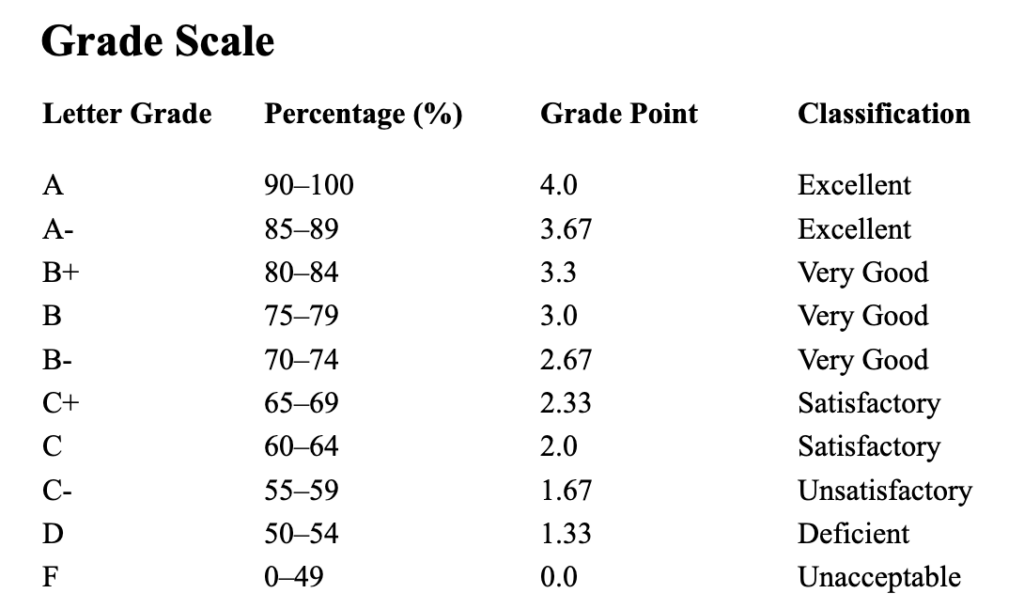
Understanding the Letter Grade Option
Students who choose the Letter Grade option will receive a formal academic grade based on their performance in course assignments and assessments.
The final letter grade is determined by:
- the average of assignment grades,
- participation and assessments where applicable,
- and the weighting assigned by the course instructor.
The course instructor is responsible for:
- grading assignments,
- determining the value or weight of each assignment,
- and calculating the cumulative final grade.
Grading System
What the Grades Mean
Excellent (A / A-)
Students demonstrate:
- excellent understanding of course content,
- strong critical thinking and analysis,
- evidence of extensive reading and preparation,
- high levels of originality and problem-solving,
- and exceptional performance independently or in groups.
Very Good (B+ / B / B-)
Students demonstrate:
- very good understanding of course content,
- strong analytical and communication skills,
- evidence of substantial preparation,
- creativity and problem-solving ability,
- and effective independent or group work.
Satisfactory (C+ / C)
Students demonstrate:
- acceptable understanding of course content,
- some evidence of preparation and background reading,
- acceptable analytical and communication skills,
- and satisfactory participation in individual and group work.
Unsatisfactory (C-)
Students demonstrate:
- limited understanding of course content,
- little evidence of preparation,
- weak analysis and communication,
- and below-acceptable performance in coursework and participation.
Deficient (D)
Students demonstrate:
- deficient understanding of course content,
- absence of problem-solving and analytical skills,
- poor communication and performance,
- and difficulty functioning independently or collaboratively.
Unacceptable (F)
Students demonstrate:
- failure to understand course material,
- lack of participation and preparation,
- inability to demonstrate required competencies,
- and unacceptable overall performance.
Please write to the instructor, cc pdi@usc.edu, for clarification on any aspects of the course content, methodology and assessment.
PDI manages the record-keeping and issuance of certificates. Please write to pdi@usc.edu.tt for any additional information and/or clarification.
Frequently Asked Questions
Are these certificate courses?
Yes. A certificate course is a short-term, specialised programme designed to teach specific skills or provide expertise in a particular area. USC is 99 years old, and is the 3rd largest and 3rd highest ranked university in Trinidad and Tobago.
Is there a registration fee?
No, there is no registration fee for PDI courses.
Is there a certificate fee?
No, there is no certificate fee.
Is there a mailing fee?
No, there is no mailing fee. On successful completion of the course, PDI will ask you to reconfirm your full mailing address and your certificate will be mailed to you.
Are there payment options available?
Yes, there are payment options based on the duration of the course. PDI will send you the payment options via email or whatsapp.
What are the payment methods?
There are three methods:
- By credit/debit card, via Aeorion, USC-PDI’s payment portal
- By national or international wire transfer to USC’s account at Republic or Royal Bank in Trinidad
- By deposit to USC’s account at Republic or Royal Bank in Trinidad and tobago
What are the course delivery methods?
There are four delivery methods, viz:
- Face-to-face or in-person classes on one of USC’s campus as published
- Virtual classes on virtual platforms like Moodle or Zoom
- Online, asynchronous classes where students study at their own pace
- Hybrid or mixed-mode classes in which more than one delivery method is used during the class.
Are there any prerequisites?
Most PDI courses do not have formal prerequisites. However, some advanced or specialised courses may recommend prior experience or foundational knowledge. Specific requirements, if any, will be listed in the course description.
What are the main elements of a course?
- Course Title
- Start and end dates
- Class days and times
- Professional Development Hours (PDHs) – hours of classroom contact and assignments
- Objectives and Learning Outcomes
- Themes – these are some of the key themes/areas of focus in the course.
- CQF Level – the CARICOM Qualifications Framework to which each course is pegged
Contact PDI
Tel: 1-868-662-2241 , 1-868-612-4872 Ext 1051
WhatsApp: 1-868-471-7272
E-mail: pdi@usc.edu.tt